
Security Signals That Matter
How Experienced DeFi Operators Evaluate Protocol Safety
As previously discussed, an audit badge does real work. It signals that someone examined the code. It tells you the team cared enough to pay for external scrutiny. It pre-empts some categories of obvious failure.
But an audit answers a narrow question: did the code behave correctly under inspection?
That is not the same question as: will the system survive a real crisis?
Experienced operators know the difference. They evaluate protocols using a stack of known security signals rather than a single badge.
Here is how that evaluation goes.
Reminder: What an Audit Covers
An audit is a snapshot of the code at one moment in time. It says nothing about what happens when real capital enters the system, when governance actors disagree, or when market conditions that designers didn’t anticipate arise to create new attack surfaces.
Audits test smart contract logic against known vulnerability patterns. They check access controls. They verify that the code does what it claims to do.

They don’t (and essentially can’t) test for economic incentives, governance capture, oracle manipulation, upgrade risks, or operational mistakes.
The point is… correct code can still be involved in catastrophic user outcomes.
Several major exploits in DeFi occurred without any bugs in the code at all.
The Strongest Signal: Survival
Battle-tested code is the strongest security signal available.
Experienced DeFi Operators ask: how long has this system been running? Has it processed billions in real transactions? Has it survived liquidation cascades, market crashes, protocol stress?
Attackers probe deployed systems continuously. Time in production creates adversarial pressure no audit team can replicate. Uniswap, MakerDAO, and Aave have been attacked, probed, and manipulated by people whose entire job is to find exploits. They are still running.
Survival is information.
A protocol with six weeks of TVL and a clean audit has not been tested. It has been glanced at.
Risk Categories
An audit cannot tell whether a system’s economic incentives will survive adversarial conditions. Deeper analysis is required.
Two categories of risk exist almost entirely outside the scope of an audit.
The first is governance and upgrade risk. If a protocol has admin keys, upgradeable proxy contracts, or concentrated governance voting, the currently deployed code matters a lot less than you might assume.
A system that can be rewritten overnight carries fundamentally different risk from a system that cannot change. An audit of last month’s code tells you nothing about what the code will look like next month.
Experienced DeFi operators ask these (political and structural) questions:
· Who controls upgrade keys?
· Can parameters change overnight?
· How concentrated is governance voting power?
The second category is economic design. Several of history’s largest DeFi exploits have not been driven by hacks in any traditional sense. They have included things like:
· logical attacks
· oracle manipulation
· liquidity drain mechanisms
· governance vote capture
These types of attacks exploit incentive structures rather than buggy code. Contracts can execute exactly as written, and outcomes can be catastrophic anyway.
Continuous Testing vs. a Snapshot
Bug bounty programs have a much bigger real-world impact than most people realize.
Audits are one-time events. Bounty programs are permanent pressure. A meaningful bug bounty (large enough to attract serious researchers and running on a credible security platform) means the protocol is being actively tested at all times by people with financial incentive to find problems.
The size of the bounty is also valuable information to factor into analysis. A $100,000 maximum payout signals a different security posture than a $10,000,000 cap.
Audits test code once. Bounties test code forever.
Serious Protocols Visibility
There is a final signal that receives less attention than it deserves: operational transparency.
Protocols that have clear governance documentation, public incident response procedures, active on-chain monitoring, and open communication after problems occur demonstrate organizational discipline (separate and distinct from technical discipline).
A protocol that goes dark after an incident, or that has no documented process for handling one, is a different level of risk compared to a protocol that communicates openly and upgrades its procedures.
Transparency does not guarantee safety. But its absence often indicates higher risk.
Final Thoughts
Most retail participants stop digging after glancing at a protocol’s audit badge because it’s visible and assumed to carry a certain authority. It fits neatly on a webpage. It is psychologically effective at quickly converting anxiety into confidence.
Experienced DeFi operators ask a different set of questions:
· Has this system survived real attacks?
· Who can change it, and under what conditions?
· What incentives shape behavior when things go wrong?
· How does the team respond when something breaks?
The difference between those two approaches is not sophistication for its own sake. It is the difference between true measurement and false confidence.
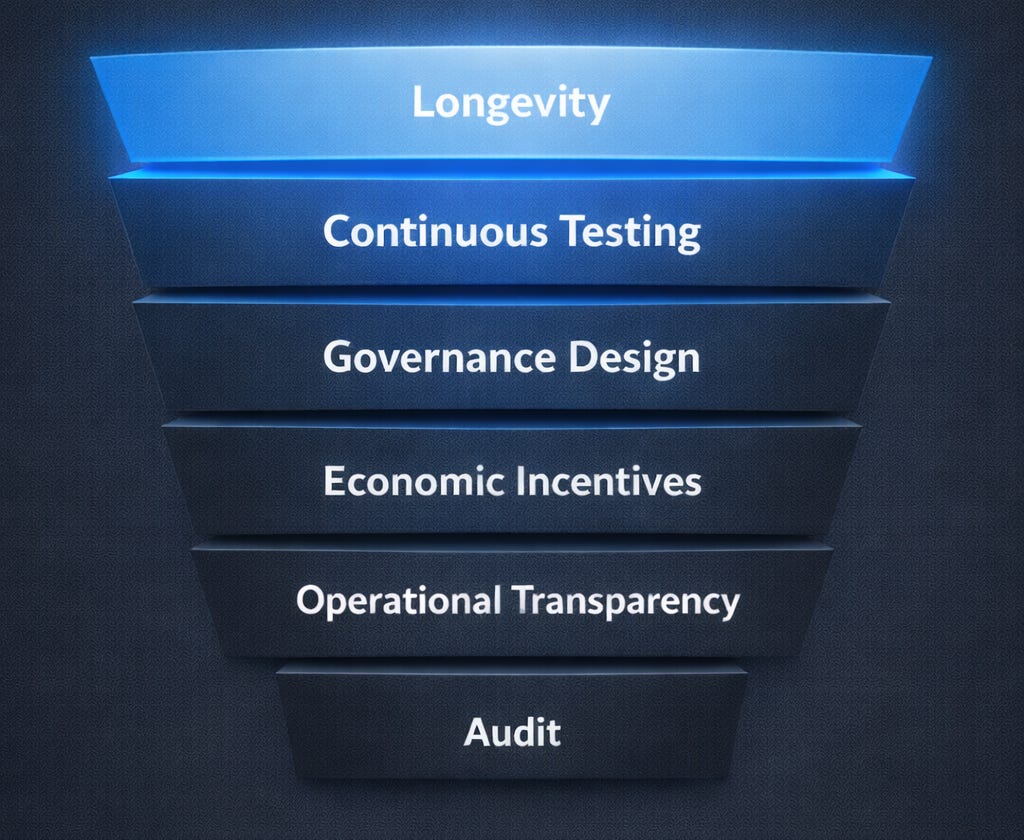
Operators who survive multiple cycles treat security as a stack, not a badge. The stack includes longevity, continuous testing, governance design, economic incentive modeling, and operational transparency. And audits, which are useful but not sufficient, and live at the bottom of the stack.
Thank you for reading.
Unclear on something? Want a topic covered? Submit Your Questions Here
I read everything. Good questions may become future posts.
If this analysis was useful, Moondance Research goes deeper.
I publish one paid piece each week focused on structural risk, capital protection, and honest yield literacy.
Paid subscribers receive the full archive, reference-grade frameworks, and downloadable artifacts designed to reduce the probability of getting financially wrecked.
Founding 100 subscribers receive permanent preferred pricing as recognition for supporting Moondance in its earliest phase.