
Why "Audited" Doesn't Mean Safe in Crypto
Code Correctness is Not the Same as System Safety
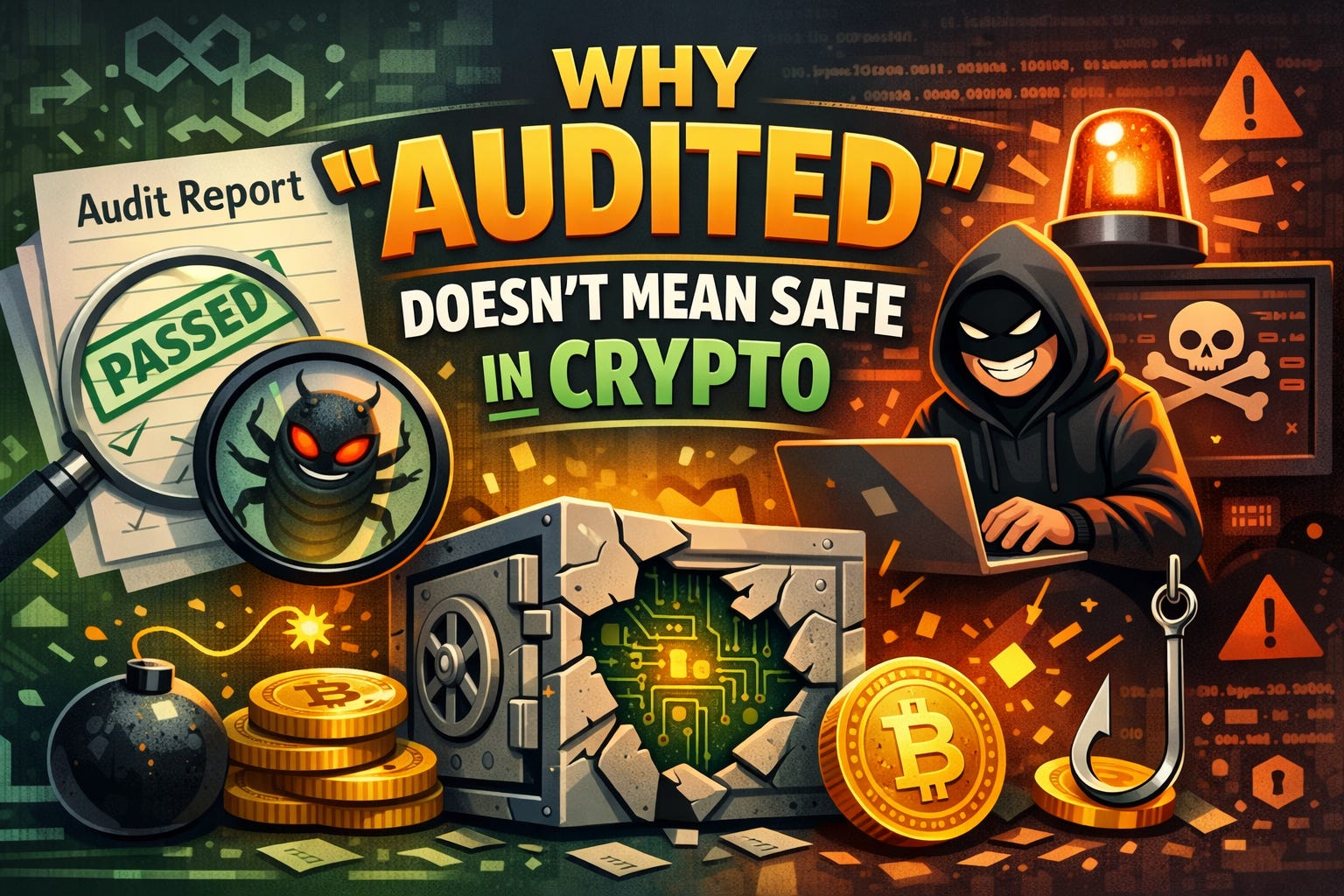
Most people treat a security audit of a crypto protocol like a gold-star safety certification.
It is not.
An audit is a report on code behavior at a specific moment in time.
It describes whether the code behaves as specified under the conditions tested.
It does not tell you:
whether the business model is sustainable
whether incentives remain aligned over time
whether the team will change the code later
whether the economic design creates hidden risks
whether users will interact with the system as intended
whether any affiliated token introduces regulatory exposure
Confusion on these points costs people money.
Why the Misconception Persists
Security audits in traditional finance carry regulatory weight.
They are tied to enforceable standards and ongoing accountability.
In crypto (as of this writing in Jan. 2026), things… don’t work that way.
Anyone can commission an audit.
The scope is defined by the party paying for it.
Auditors carry no ongoing liability if the protocol fails.
The code can change immediately after the report is published.
The word “audited“ signals professionalism.
It implies oversight.
In practice, it merely means:
The team paid for third-party review
The code matched the specification at the time
No critical vulnerabilities were found within the tested scope
That last part matters. The tested scope is almost always narrower than users assume.
What an Audit Actually Covers
A typical smart contract audit examines:
Code correctness
Known vulnerabilities
Behavior under some edge case inputs
Auditors do not evaluate:
Economic sustainability
Governance control and upgrade risk
Incentive design and extraction paths
External dependencies
User behavior under stress
Regulatory exposure
An audit might confirm that a liquidation mechanism executes as written.
It does not tell you whether collateral assets are correlated.
It does not tell you whether liquidations will clear during a crash.
It does not tell you whether an oracle price feed will fail when volatility spikes.
Those are system design and integration questions.
Audits are just code reviews.
The Scope Problem
Crypto audits are almost always scoped by the client.
Scope often excludes:
the frontend users interact with
governance modules controlling upgrades and parameters
funds routed through third-party routines
dependencies inherited from other protocols
Even within scope, time and budget are constraints.
Auditors may have days or weeks to review code written over months.
High-severity issues are flagged.
Lower-priority issues are documented.
What actually gets fixed is entirely up to the team.
The presence of an audit tells you nothing about what may have been omitted.
What Changes After the Audit
Code often does change after an audit.
Upgradeable contracts allow teams to modify logic and/or parameters without triggering a new review.
The original audit language may remain public even when production code no longer matches it.
This is not automatically malicious; upgrades can be necessary.
But it means the touted audit may describe a system that no longer exists.
Even without upgrades, protocol behavior may change based on:
governance votes
market regime shifts
userbase changes
liquidity migration
Audits capture a snapshot.
They do not model system evolution.
The Incentive Layer
Most protocol failures are not code exploits. They are incentive collapses.
Examples:
yield driven by emissions that decay faster than trust
liquidity structures that depend on continuous inflows
governance systems vulnerable to concentration
treasury extraction framed as “community decisions”
These are design failures.
They reflect shady human behavior.
They are invisible to static code review.
Code audits do not catch them because they are not bugs.
How to Think About Audits
Crypto audits are useful.
They reduce the probability of catastrophic code failure.
They indicate a minimum threshold of seriousness.
They are not guarantees.
An audit should be treated as one input among many.
Other inputs matter more:
who is in control of upgrades and pauses
how parameters are changed
which external systems the protocol depends on
how value flows to the team
whether the protocol has survived stress
what happens when growth stops
Audits answer a narrow question.
They do not answer the primary question: “Is this safe?”
What This Means Practically
“Audited” is baseline hygiene.
It is not evidence of safety.
Before interacting with a protocol:
read the audit and check the scope
verify whether the code has been changed since
identify who owns the code
evaluate the economic model separately
consider whether it has operated under high-stress conditions
look for evidence of compliance with applicable laws and regulations
If any of this information is unavailable, that is itself a signal.
Categorical Error
An audit reduces one class of risk.
It does not eliminate risk.
Treating “audited” as synonymous with “safe” is a categorical error.
It assumes that code correctness is the dominant failure mode in crypto systems.
It rarely is.
Most losses come from incentives, governance, economics, or user behavior.
Audits are not designed to evaluate those.
Crypto audits are tools.
And tools only function when used with sound judgement.
Thank you for reading.
Unclear on something? Want a topic covered? Submit Your Questions Here
I read everything. Good questions may become future posts.
If this analysis was useful, Moondance Research goes deeper.
I publish one paid piece each week focused on structural risk, capital protection, and honest yield literacy.
Paid subscribers receive the full archive, reference-grade frameworks, and downloadable artifacts designed to reduce the probability of getting financially wrecked.
Founding 100 subscribers receive permanent preferred pricing as recognition for supporting Moondance in its earliest phase.