
Where Crypto Yield Actually Comes From
(And Why Most of It Isn’t Real)
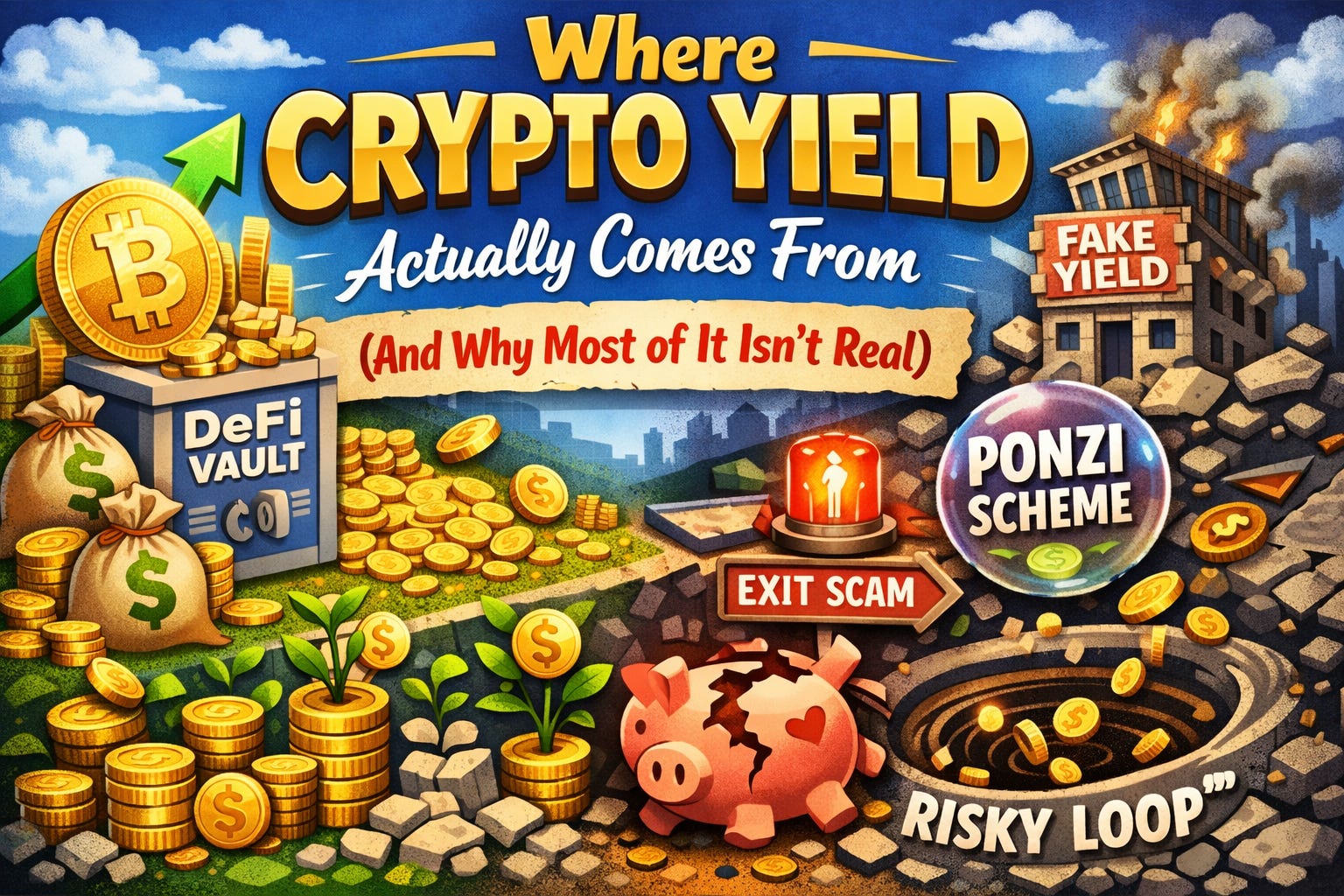
Yield is the gravitational center of crypto.
It is how DeFi systems attract users.
It is how risk is softened.
It is how fragility is often ignored.
Most people never ask a basic question:
Where does yield actually come from?
Before you can evaluate yield, you have to classify it.
Definition
For readers new to the term: “yield” is the return you receive over time for allowing someone else to use your money or assets.
What “Yield” Usually Means
Outside of crypto, yield is boring.
It comes from:
lending money
business activity
fees for real services
It usually corresponds to:
time
risk
or economic output
Crypto uses the same word, but it often means something else entirely.
A Note on Speculation
Speculation is the most common source of returns in crypto.
It is also the most misunderstood.
Buying something with the expectation that it can be sold later for more is not yield.
It is a belief about future transfer.
Speculation is not fake.
It is just not a consistent or predictable source of returns.
When returns depend on someone else paying more later, new value is not being created. It is being passed along from one holder to the next.
With that distinction in mind, we can talk about where crypto “yield” actually comes from.
The Three Sources of Crypto Yield
Almost all crypto yield falls into one of three categories.
1. Transfer
Transfer-based yield comes from other participants.
It includes:
trading losses
liquidation penalties
forced exits
uneven fee distribution
This is common in:
leveraged trading venues
liquidation-driven lending systems
fee redistribution models
In these systems, one person’s yield is another person’s loss.
Transfer-based yield is not fake.
It is competitive.
Examples of transfer-based yield (structural examples, not endorsements or recommendations):
Uniswap v3 LP fees (funded by trader losses to volatility and slippage)
Aave liquidation penalties (paid by over-leveraged borrowers)
GMX trader losses (redistributed to liquidity providers)
2. Subsidy
Subsidized yield is paid for, not earned.
It comes from:
token emissions
treasury reserves
investor capital used to buy usage or liquidity
Subsidies are often used to bootstrap activity in a protocol’s earliest days.
The problem arises when temporary subsidies are mistaken as permanent.
Subsidized yield can look identical to real yield at first.
It feels stable until it isn’t.
When the subsidy ends, yield often disappears with it.
Examples of subsidized yield (structural examples, not endorsements or recommendations):
Curve’s CRV token emissions (paying LPs to attract liquidity)
Blur’s BLUR token rewards (paying traders to use the platform over competitors)
Most “liquidity mining” programs (temporary incentives funded by treasuries)
3. Extraction
Extraction-based yield comes from asymmetry.
It relies on:
uneven information
opaque fee structures
preferential access or exits
governance arrangements that favor some participants over others
This shows up in systems where:
insiders exit differently
operators have priority
risk is distributed unevenly
Extraction often looks like yield until you ask who is paying.
Examples of extraction-based yield (structural examples, not endorsements or recommendations):
Tokens with asymmetric vesting (insiders unlock early, retail locked long-term)
Protocols with admin keys that can change fee structures mid-flight
Systems where governance voters extract value from non-voting token holders
Where Real Yield Actually Exists
Real yield does exist in crypto.
It is usually:
smaller
capacity-constrained
sensitive to conditions
tied to real fees or demand
It tends to compress over time as competition increases.
It rarely scales cleanly.
It is rarely exciting.
Real yield often looks disappointing next to advertised yield.
That is usually the point.
Why High APY Is the Wrong Signal
High APY is easy to display.
The better questions are:
Who is paying this?
Why are they paying it?
What changes when conditions change?
Most DeFi systems blend multiple sources.
A pool might offer:
2% from real activity
8% from subsidies
15% from governance token speculation
The dashboard shows 25%.
The real return might be negative.
Understanding yield explains why people enter systems.
It does not explain why they lose money.
What to Ask
Before evaluating yield, classify it:
Where does this come from?
Who is paying for it?
What happens when conditions change?
Most high yield is subsidy or transfer dressed as sustainability.
Understanding the difference is the first filter that matters.
Thank you for reading.
Unclear on something? Want a topic covered? Submit Your Questions Here
I read everything. Good questions may become future posts.
If this analysis was useful, Moondance Research goes deeper.
I publish one paid piece each week focused on structural risk, capital protection, and honest yield literacy.
Paid subscribers receive the full archive, reference-grade frameworks, and downloadable artifacts designed to reduce the probability of getting financially wrecked.
Founding 100 subscribers receive permanent preferred pricing as recognition for supporting Moondance in its earliest phase.