
What Moondance Refuses to Build
Structural Boundaries for Building Durable DeFi Tooling
Most crypto projects fail the same way.
A team raises money through a token. They promise governance rights and future utility. They pay early users in emissions. The token launches at an inflated valuation.
Eighteen months later, the token is down >80%. The team blames “market conditions.” Users realize the yield was always temporary.
I’ve watched this pattern repeat since I got into crypto in 2017. It is now documented at scale.
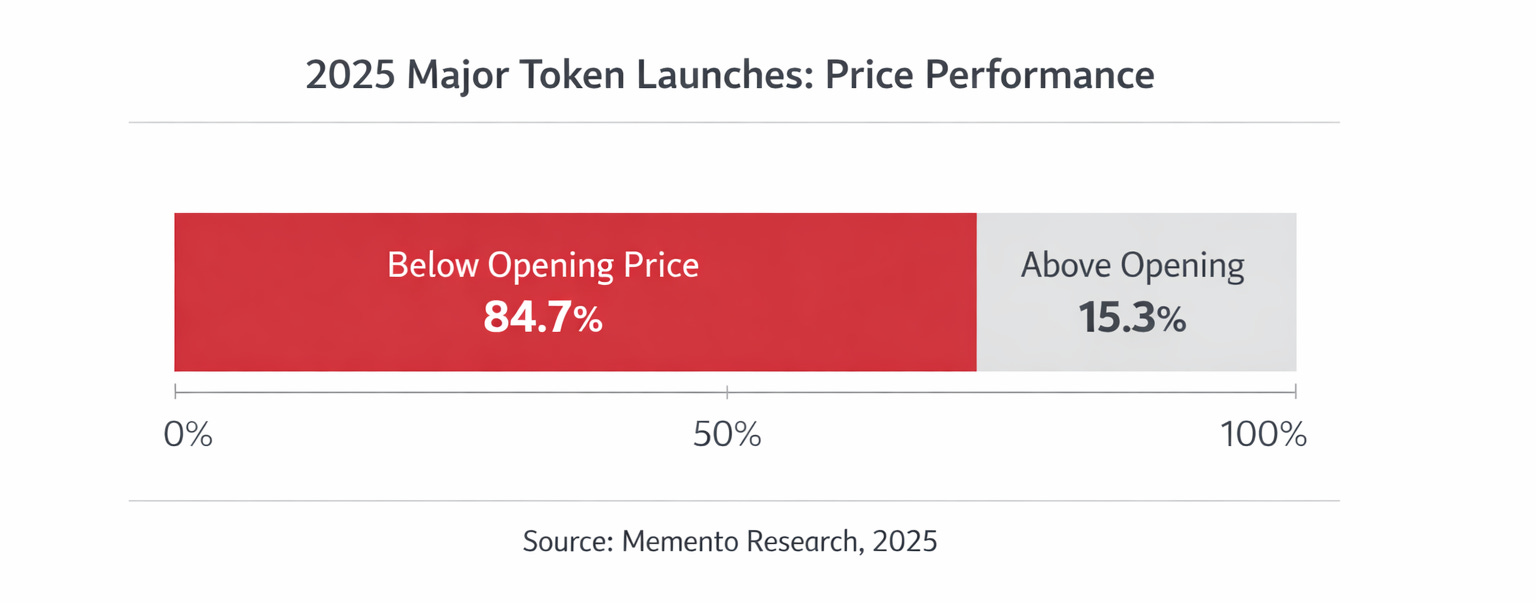
In 2025, 84.7% of major token launches traded below their opening price. The median drawdown was 71%. Over half of all tokens launched since 2021 no longer trade at all.
The SEC has named governance tokens (including BNB, ADA, MATIC, etc.) as unregistered securities in active enforcement cases. Courts have repeatedly ruled that when buyers expect profit from a team’s ongoing efforts, that’s an investment contract under U.S. securities law.
The regulatory risk isn’t theoretical. It’s being litigated right now in federal court.
A Simple Durability Test
When evaluating a DeFi system, four basic questions apply:
Does revenue exist without issuance of a new token?
Does yield persist if token emissions stop tomorrow?
Would the system survive an 80% token drawdown?
Could it function and profit without custody of user funds?
If the answer to any of these is no, the design is dependent on a variable outside its control. Dependency is not automatically fatal, but it must be acknowledged.
Durability in crypto rarely comes from clever token design. It comes from boring economics:
Fee revenue
Clear ownership boundaries
Limited regulatory exposure
Incentives that survive price volatility
What I Won’t Build, Part 1: A Governance Token
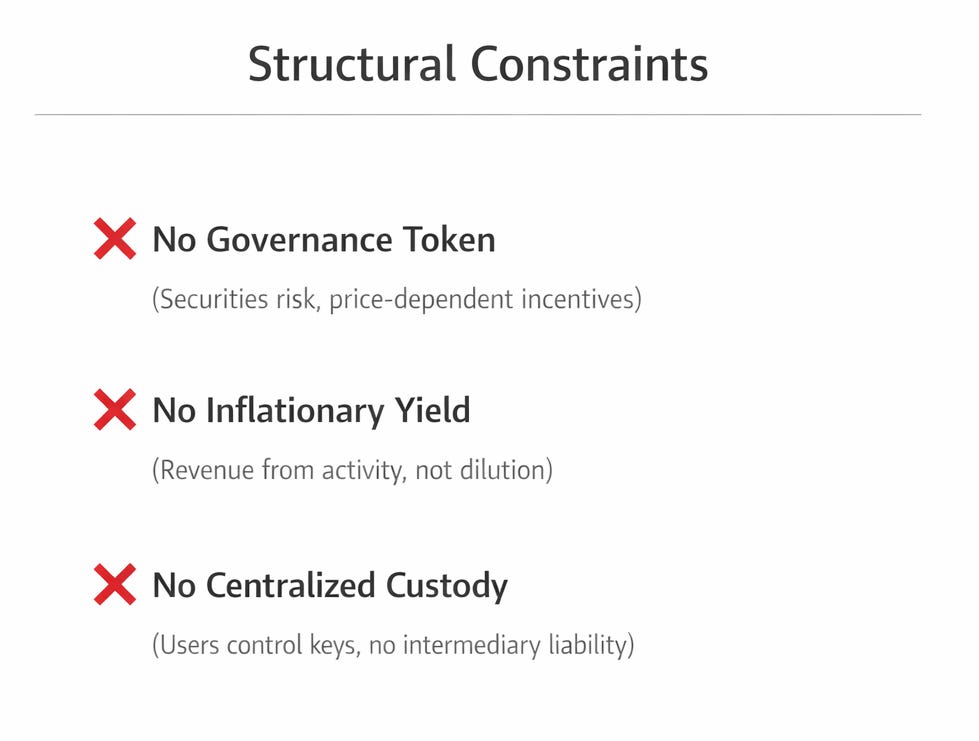
I will not issue a token to raise capital or reward early supporters.
Many governance tokens function economically as investment contracts, regardless of how teams label them. The economic structure creates securities risk whether or not founders acknowledge it.
When you buy a token expecting the founding team to build the protocol, grow the ecosystem, and create value that accrues to token holders, you’re participating in an investment contract. The spin doesn’t matter. The economic reality and the law very much do matter.
Courts have repeatedly ruled that governance tokens structured as investment contracts violate securities law. No new token design can change that reality.
What I Won’t Build, Part 2: An Inflationary Yield Protocol
I will not build a protocol that pays 50+% APY in its own token while diluting holders.
Real yield comes from real, well-executed economic opportunity: fees, trading activity, lending spreads, arbitrage, etc. Fake yield comes from printing tokens faster than economic activity can support. When demand slows, dilution dominates.
This publication will explore and explain where sustainable yield exists and how to identify it. I won’t participate in creating temporary yield to bootstrap a product, leaving users holding worthless tokens six months later.
What I Won’t Build, Part 3: Centralized Custody
I will never hold user funds or operate as an intermediary.
Any yield-related products I build will either be self-hosted tools users can run on their own infrastructure or read-only intelligence surfaces. Users will always control their keys, their configuration, their execution, and their decisions.
Moondance will avoid operating in regulatory categories that carry custody or intermediary liability.
What I’m Exploring Instead
Solana tooling and analytics infrastructure are maturing fast, but there are still significant gaps in how operators track risk, monitor governance changes, identify sustainable yield opportunities across protocols, see the full (non-protocol-dashboard) truth behind positions and transactions, etc.
Beyond my commitment to writing Moondance Research, I’m actively investigating the feasibility of building novel DeFi tooling to fill those gaps in the Solana ecosystem.
The idea is to make Solana DeFi safer and more transparent for operators who want to participate in good faith. I’m exploring areas like governance monitoring, risk aggregation, and incentive transparency.
What This Means
Future Moondance ecosystem products will follow the same model as Moondance Research: my income will accrue from users who decide that paying for intelligence/capability is in their own self-interest. Not from shared speculation on a new token.
A large, successful, sustainable blockchain intelligence industry already runs this way. Real companies make money by providing new value to the market, not by issuing governance tokens. That same structure will translate and work for advanced Solana DeFi tooling.
Moondance Research will continue to focus on:
Where legitimate crypto yield comes from
How to identify structural risks before deploying hard-earned capital
Why nearly all high-APY opportunities are actually extraction schemes
Which DeFi mechanisms produce sustainable returns and which do not
My writing assumes that you’re an adult who can handle nuance. I don’t tell you what to buy or promise returns. I expose you to frameworks for thinking deeply about opportunity and risk.
Subscribers will be among the first to know about new projects as they come to fruition.
Thank you for reading.
Unclear on something? Want a topic covered? Submit Your Questions Here
I read everything. Good questions may become future posts.
If this analysis was useful, Moondance Research goes deeper.
I publish one paid piece each week focused on structural risk, capital protection, and honest yield literacy.
Paid subscribers receive the full archive, reference-grade frameworks, and downloadable artifacts designed to spot opportunities and reduce the probability of getting financially wrecked.
Founding 100 subscribers receive permanent preferred pricing as recognition for supporting Moondance in its earliest phase.